Nice App. Shame About the Boiler: The Smart Heating Check Most UK Homes Skip
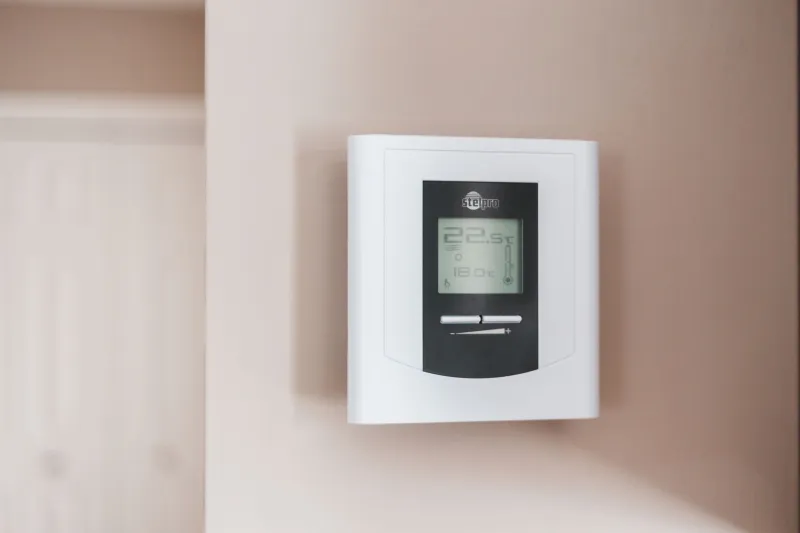
There's a particular kind of disappointment that arrives about three weeks after a smart thermostat goes on the hallway wall. The app is lovely. The little flame animation is charming. The schedules are set, the geofencing works, and the house is... about as warm as it was before, for roughly the same money. Nothing is broken. It's just that the clever part of the purchase was never the thermostat. It was the conversation between the thermostat and the boiler — and a lot of British homes are having that conversation in grunts.
The thing nobody photographs
Strip away the glass and the scheduling and what you've bought is a switch. In the overwhelming majority of UK installations, that switch opens and closes a circuit and the boiler responds by firing up at whatever flow temperature its own dial is set to. That's it. On, off, repeat.
So when a manufacturer's marketing talks about "intelligent heating" and "up to 20% savings", it's describing a best case built on a system that can do more than switch. If your boiler can only hear "go" and "stop", you've bought a very nice timer with Wi-Fi. Which is genuinely useful — but it isn't the thing on the box.
It's worth knowing that since 2018, Boiler Plus rules in England have required new gas combi installs to include time and temperature controls plus one extra measure, and a smart thermostat with automation and optimisation counts towards that. That's a decent nudge towards better controls, but it doesn't guarantee your particular boiler and your particular thermostat are on speaking terms.
On, off, or somewhere in between
Here's the technical heart of it. A modern gas boiler doesn't have to run flat out. A modulating boiler can turn its flame down — often to somewhere between 15% and 30% of its rated output — and hold a steady, gentle temperature instead of blasting and resting. That's better for efficiency, better for comfort, and much kinder to the heat exchanger.
But it can only modulate if something asks it to. And the thing asking has to speak the same language.
A plain relay-switched thermostat can't do that. It can only say "fire". A thermostat connected over a digital protocol can say "give me 45°C flow, please" — and on a cold-but-not-freezing November afternoon, that's the difference between a boiler condensing nicely and a boiler running hot for twenty minutes and then sitting idle.
The language problem
OpenTherm is the best-known of these protocols, and it's widely supported across Europe. UK support is patchier and more brand-specific than the shop shelf suggests. Vaillant has its own eBUS. Worcester Bosch uses EMS. Ideal, Baxi, Glow-worm and others have their own arrangements, and some boilers that claim OpenTherm compatibility need an adapter, a specific controller, or a firmware version that your unit may or may not have.
The trap is buying by brand. A thermostat that lists "Vaillant compatible" might only mean "works as an on/off switch on a Vaillant". You want the compatibility table that lists your exact boiler model and says, in words, modulating or relay.
Two more things that quietly matter
Flow temperature. A condensing boiler only earns its name when the water coming back to it is cool enough — roughly below 55°C — for the flue gases to condense and give up their latent heat. Plenty of UK homes are running at 70°C or 80°C flow because that's what got left behind on commissioning day, and the boiler is doing barely better than a 1990s unit. Weather compensation or load compensation, where the boiler trims its flow temperature based on outside conditions or how fast the room is heating, is where the real gains sit. Ask whether your chosen controls offer it, and on which boilers.
System versus combi. If you have a system boiler with zone valves, your smart thermostat is still switching a valve, not modulating a flame. Room-by-room control can absolutely cut gas use — but it does it by heating fewer rooms, not by making the boiler cleverer.
Smart radiator valves won't rescue this
TRVs that close off individual rooms are one of the genuinely useful smart home upgrades of the past few years, particularly in a drafty Victorian terrace where you only need two rooms warm on a Tuesday. But they create a new question: what happens when six of your eight radiators shut down?
A 24kW combi asked to heat two radiators will cycle — fire, hit its minimum, shut off, cool, fire again. That's inefficient, and it's noisy. A bypass, a properly balanced system and a boiler with a low minimum output all help. None of that is in the box.
Reading the savings number properly
"Up to" is doing an enormous amount of work in heating marketing. Those figures usually come from modelling: if a household behaves in a certain way, with certain assumptions about schedules and occupancy, here is the ceiling. Independent guidance tends to be more modest — turning the thermostat down by a single degree is often quoted as cutting heating bills by around a tenth, and that saving comes from you, not from the app.
So treat any percentage as a best case, subtract a bit, and then ask whether you'd pay for the controller even if the savings landed at zero. Because the scheduling, the geofencing and the "is the house warm before I get home" convenience are real, reliable benefits. The energy savings are conditional.
Questions to ask before you pay
- What's the exact make and model of my boiler, and does it have digital modulation terminals?
- Which protocol does it use, and does the thermostat I'm eyeing support it on this model, not just this brand?
- Is my system a combi, a system boiler with valves, or a heat-only with a tank? Who controls the hot water?
- Does my wiring have the permanent live and switched live the new unit needs — and a neutral, if it wants one?
- Has anyone balanced the radiators, and is there a bypass?
- If a heat pump is on the cards within five years, will these controls come with me?
The honest bottom line
Buy the control that speaks your boiler's language. If it can't, buy it anyway if you want better schedules and a house that isn't cold when you get in — just don't buy it expecting the boiler to suddenly become efficient. That's a plumbing and commissioning job, and no app has ever fixed one of those.